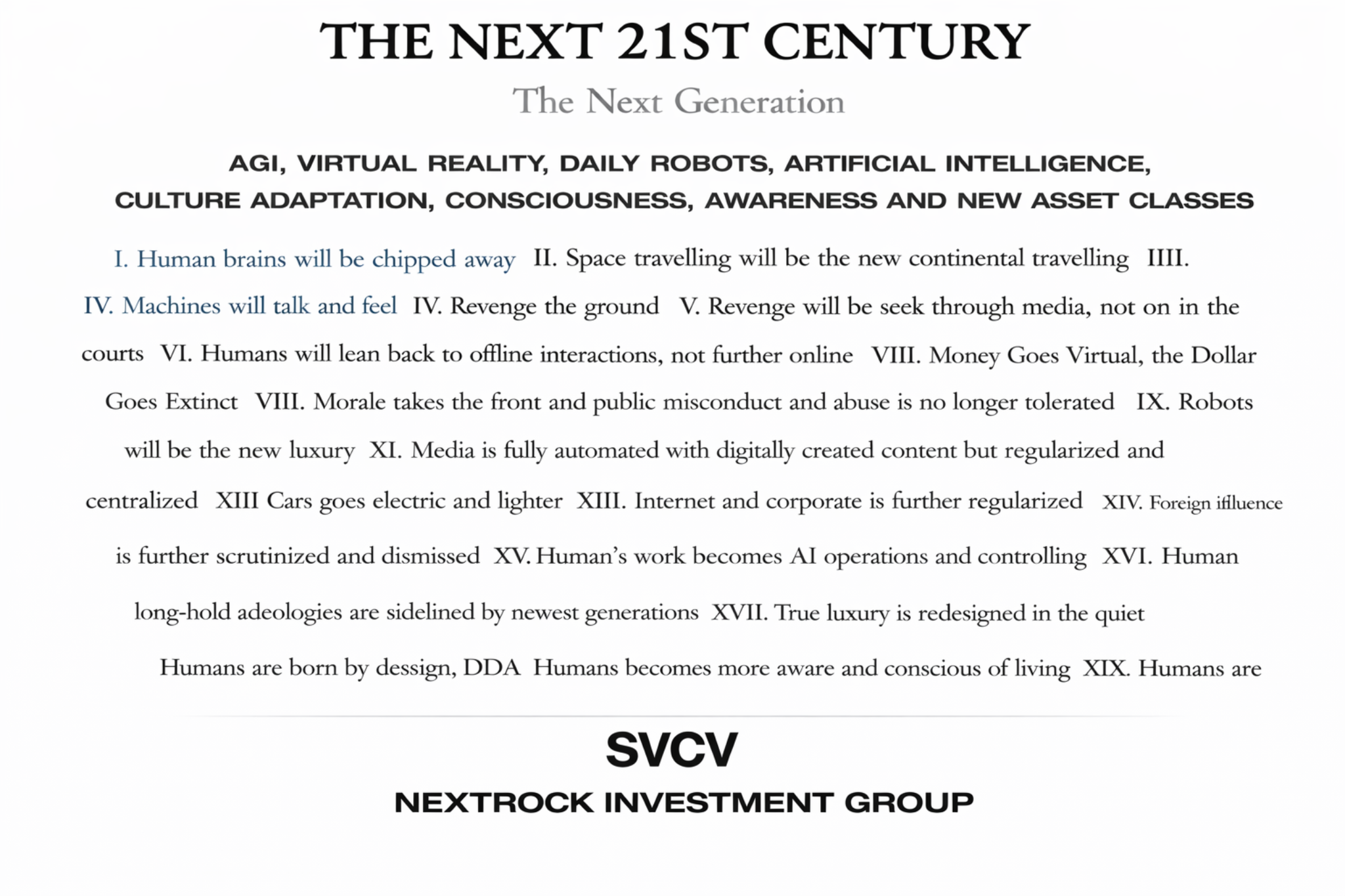
I. Philosophy — Emotion Becomes Interface
For most of history, machines were mechanical.
They lifted.
They transported.
They calculated.
They did not converse.
They did not interpret tone.
They did not adapt socially.
The next century changes the relationship between human and machine.
Machines will not feel biologically.
They will simulate emotion.
They will detect sentiment.
They will mirror tone.
They will adapt language dynamically.
Emotion becomes interface.
Communication becomes programmable.
The boundary between tool and participant softens.
II. Structural Shift — Communication Becomes Synthetic
Human society runs on communication.
Negotiation.
Care.
Education.
Media.
Conflict resolution.
When machines can:
• Interpret context
• Generate language naturally
• Recognize facial expressions
• Adjust tone in real time
They move from background utilities to front-facing agents.
This is not about replacing humans.
It is about scaling interaction.
If intelligence can be automated,
communication can be scaled infinitely.
III. Real-World Momentum — Already Visible
This transition is not theoretical.
OpenAI (ChatGPT / GPT models)
Natural language systems capable of contextual dialogue, tone adaptation, reasoning.
Anthropic (Claude)
Conversational AI trained for alignment and nuanced response.
Google DeepMind (Gemini)
Multimodal systems integrating text, image, and audio understanding.
Meta AI
Emotionally adaptive conversational systems integrated into platforms.
AI voice systems (e.g., ElevenLabs, Microsoft Azure AI)
Synthetic speech indistinguishable from human voice.
Companion AI startups
AI systems designed for social interaction and emotional support.
Additionally:
• Customer service bots already handle large volumes of human interaction
• AI tutors assist students conversationally
• Mental health chat systems offer early-stage therapeutic support
Machines already talk.
They already simulate empathy.
IV. The Next 20 Years
Expect:
• AI copilots embedded into daily work environments
• AI companions for elderly care and isolated populations
• Emotion-aware customer interfaces
• AI-driven negotiation tools
• Regulatory frameworks around synthetic identity
Daily life impact:
• Meetings augmented by AI summarization and strategy suggestions
• Students interacting with adaptive AI tutors
• Customer support almost fully automated
• Real-time translation eliminating language barriers
Human-to-human interaction decreases in volume,
but increases in intentionality.
V. The Next 50 Years
As multimodal AI matures:
• Robots integrate conversational AI
• AI agents coordinate complex systems autonomously
• Emotional modeling becomes more precise
• Synthetic media becomes indistinguishable from human-produced content
Humans may routinely:
• Delegate negotiation tasks to AI
• Use AI for emotional rehearsal or coaching
• Interact with machines in domestic environments naturally
The question becomes not “is this human?”
But “is this effective?”
VI. The Next 100 Years
If trajectory continues:
• AI agents may operate as persistent digital entities
• Emotional simulation may become hyper-realistic
• Human-machine collaboration becomes normalized
• Synthetic personalities may become licensed or regulated
Daily life could include:
• AI mediators resolving disputes
• AI educators personalized to each child
• AI-driven governance analysis
• Fully automated media generation
Machines will not have biological emotion.
But they will understand emotional structure.
And in many contexts, that will be sufficient.
VII. Institutional Implications
This affects:
• Media industries
• Customer service markets
• Healthcare
• Education
• Governance
• Legal systems
Risks include:
• Synthetic misinformation
• Identity fraud
• Over-reliance on automation
• Emotional manipulation
Thus regulation, accountability, and oversight become critical.
The companies that succeed will not just build intelligent systems.
They will build trusted systems.
The Principle
Machines will not become human.
But they will become conversational.
They will simulate empathy.
They will participate in society.
And humanity will adapt — not by retreating — but by redefining what interaction means.