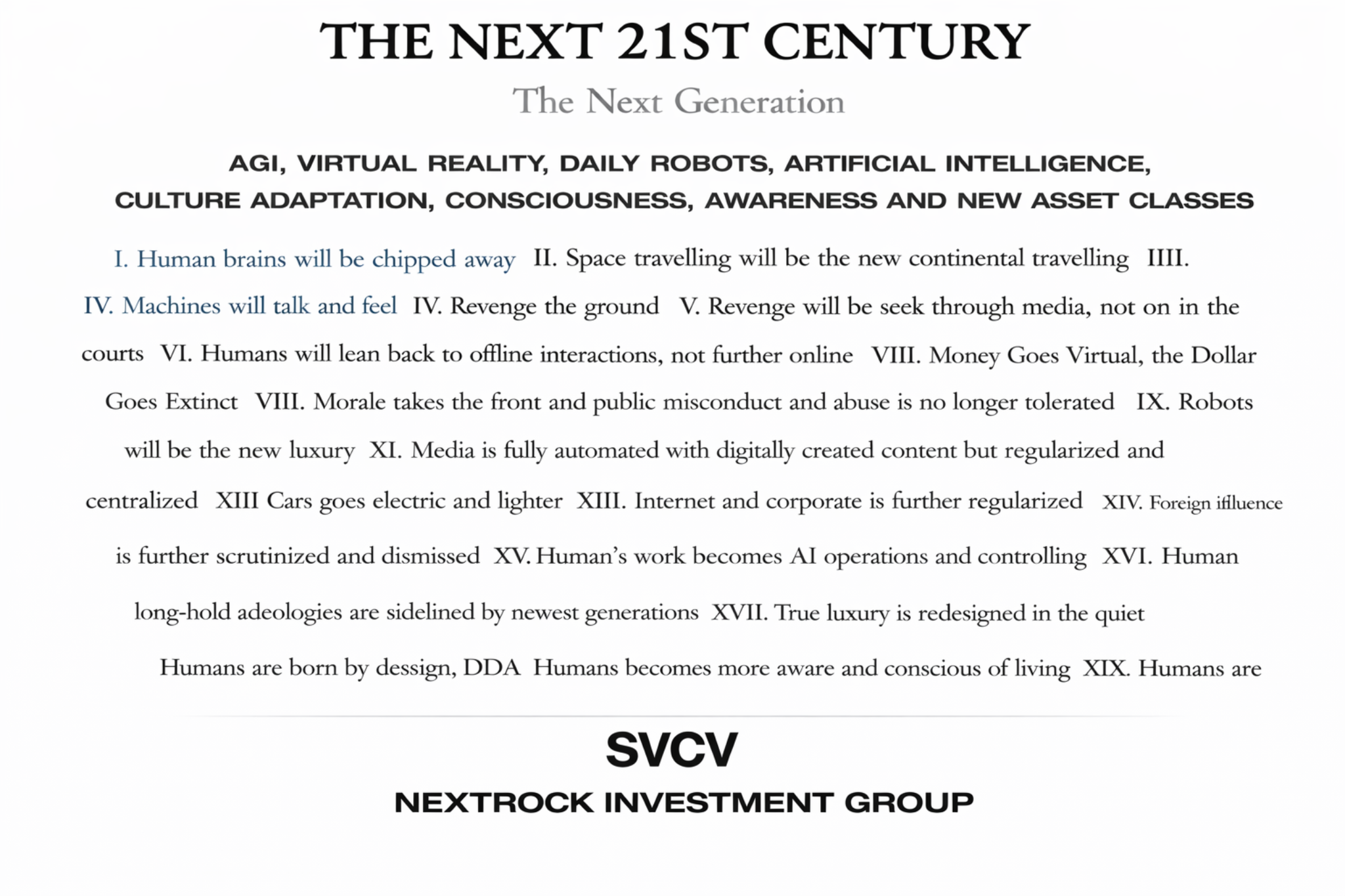
The next century will not be post-human. It will be augmented-human. Intelligence will become infrastructure. Capital that controls intelligence infrastructure will control the next economic layer.
1 – Humans brains will be chipped away
I. Philosophy — The End of Biological Limitation
For most of history, intelligence was fixed.
You were born with a brain.
You trained it.
You lived within its biological limits.
Memory faded.
Processing speed declined.
Learning required years.
The next century alters that boundary.
Human intelligence will not be replaced.
It will be extended.
The skull will no longer define cognition.
The brain will not be “chipped away” in destruction —
it will be layered, augmented, supported.
Intelligence becomes collaborative.
Human thought will increasingly operate alongside machine systems.
Not as submission.
As amplification.
II. Structural Shift — Intelligence Becomes Infrastructure
When cognition can be enhanced, three things change:
Education collapses in time
Expertise scales beyond individuals
Productivity becomes intelligence-bound, not labor-bound
The 20th century industrialized muscle.
The early 21st century digitized information.
The next phase industrializes cognition.
If knowledge can be accessed neurally,
if memory can be externally supported,
if decision-making can be AI-augmented in real time,
then intelligence itself becomes a utility layer.
Like electricity.
Like bandwidth.
Like cloud compute.
III. Technical Reality — This Is Already Underway
This is not speculative.
Brain-computer interface (BCI) systems are in human trials.
Neural implant research is advancing in:
Motor function restoration
Memory prosthetics
Paralysis treatment
Sensory restoration
Major research institutions and private companies are:
Developing implantable neural interfaces
Mapping neural signals with increasing precision
Training AI models to interpret brain activity
Parallel to implants, non-invasive systems are advancing:
EEG-based cognitive monitoring
AI-assisted focus and fatigue detection
Real-time neurofeedback tools
Meanwhile, cognitive enhancement is already happening externally:
AI copilots assisting doctors, lawyers, engineers
Real-time translation systems augmenting communication
Knowledge retrieval systems collapsing research time
Even without implants, humans are already cognitively augmented through AI layers.
Neural hardware is simply the next interface step.
IV. Investor Implications
Cognitive augmentation unlocks entire markets:
Neurotechnology
Cognitive health
Longevity & brain preservation
AI-human interface design
Memory enhancement systems
Neuro-data security
This is not a gadget cycle.
It is the beginning of a new capital frontier:
Human Intelligence Infrastructure.
And as intelligence becomes augmentable,
ethical oversight becomes central.
Governance, regulation, and trust will define leaders.
V. The Principle
Human beings will not surrender agency.
They will extend it.
Brains will not be diminished.
They will be expanded.
The next century will not remove humanity from intelligence.
It will multiply it.
V. Real-World Momentum — And the Next 100 Years
This transition is already visible.
Companies and Research Active Today
Neuralink – Developing implantable brain-computer interfaces to restore motor function and enable neural signal translation.
Synchron – Conducting human trials for minimally invasive neural implants enabling paralyzed patients to communicate digitally.
Blackrock Neurotech – Long-running neural interface research in clinical settings.
DARPA-backed programs – Funding neuroprosthetics and cognitive restoration for over a decade.
Kernel – Developing non-invasive brain recording systems.
Parallel augmentation is happening outside the skull:
OpenAI / Anthropic / Google DeepMind – AI copilots assisting coding, research, legal drafting, medical diagnostics.
Microsoft Copilot / GitHub Copilot – Augmenting daily productivity.
AI-driven clinical decision tools – Supporting physicians in diagnostics.
Even without implants, cognitive augmentation is already embedded in daily workflows.
The interface today is a screen.
Tomorrow it may not be.
The Next 20 Years
Expect:
• Medical-first adoption (paralysis, neurodegeneration, memory disorders)
• Defense and research sector experimentation
• Elite professional augmentation (high-complexity industries)
• Tighter regulation around neural data privacy
Daily life impact:
• Faster learning
• Reduced research time
• Real-time translation
• AI-assisted decision making becomes normal
The augmentation layer remains external but constant.
The Next 50 Years
Neural interfaces likely become:
• Minimally invasive
• Elective for cognitive enhancement
• Integrated with AI assistants
• Securely cloud-linked
Education may compress dramatically.
Language barriers decline.
Memory recall becomes assisted.
Work shifts further from execution to oversight.
The human brain becomes networked — selectively and securely.
The Next 100 Years
If trajectory continues:
• Intelligence becomes partially modular
• Learning cycles shorten dramatically
• Cognitive decline becomes manageable
• Human lifespan expands alongside cognitive health
• Human-machine collaboration becomes default
Daily life may look like:
• Thought-activated systems
• Seamless communication across languages
• Augmented creativity
• Enhanced problem-solving capacity
• Fewer manual cognitive bottlenecks
But also:
• Strict neuro-rights legislation
• Data sovereignty frameworks
• Ethical boundaries around enhancement
Society will need governance as much as innovation.
The Structural Impact
If intelligence becomes augmentable:
• GDP becomes intelligence-bound
• Productivity becomes cognition-bound
• Talent scarcity decreases
• Competitive advantage shifts to augmentation infrastructure
The future economy will not just depend on capital.
It will depend on enhanced cognition.
The Principle
This is not about replacing humans.
It is about compounding them.
The next century will not be post-human.
It will be augmented-human.
And institutions that understand this early will build the infrastructure of intelligence itself.